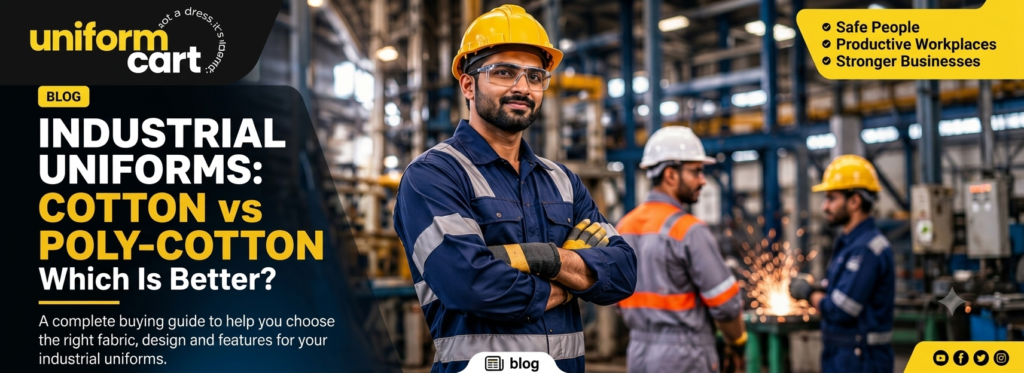
A practical buying guide to industrial uniform fabrics, durability, comfort, safety features, and bulk ordering.
Introduction
Choosing the right industrial uniform is important for employee comfort, workplace practicality, and a professional company image. The fabric you select can influence breathability, durability, maintenance requirements, and overall uniform cost.
One of the most common questions industrial buyers ask is: Is cotton or poly-cotton better for factory workers?
The answer depends on the working environment, temperature, type of work, washing frequency, and required safety features.
At UNIFORM CART, we help businesses evaluate uniform options for different industrial applications, from standard factory uniforms to reflective workwear and specialised protective clothing.
1. Why Is Industrial Uniform Fabric Important?
Industrial uniforms are used in factories, workshops, warehouses, engineering facilities, construction environments, and manufacturing units.
The right fabric should be selected according to:
– Workplace temperature and ventilation.
– Physical activity and employee comfort.
– Frequency of washing and expected garment life.
– Resistance to everyday wear and tear.
– Required pockets, closures, reflective details, and reinforcements.
– Any specific workplace hazards and applicable safety requirements.
Important: Ordinary cotton or poly-cotton workwear is not automatically protective clothing. Where employees face heat, flames, electrical hazards, chemicals, or other risks, the garment must meet the relevant protective requirements for that application.
2. Cotton vs Poly-Cotton: What’s the Difference?
100% Cotton
Cotton is a natural fibre valued for its breathability and comfortable feel.
Advantages
– Comfortable for many everyday work environments.
– Good moisture absorption.
– Can be suitable for hot workplaces when the garment construction is appropriate.
– Available in a range of weights and fabric constructions.
Things to consider
– May wrinkle more easily.
– Shrinkage can occur if the fabric is not properly processed or cared for.
– Drying time and maintenance requirements may be higher.
– Ordinary cotton is combustible and is not a substitute for certified flame-resistant workwear.
Best suited for: Selected factory, workshop, and general workwear applications where comfort and fabric feel are priorities.
Poly-Cotton
Poly-cotton combines polyester and cotton. Its properties depend on the blend ratio, fabric construction, finishing, and garment design.
Advantages
– Often offers a useful balance of comfort and durability.
– Generally easier to maintain and less prone to wrinkling than many 100% cotton fabrics.
– Can provide good dimensional stability and colour retention when properly specified.
– Available in multiple weights and blend ratios for different applications.
Things to consider
– Breathability and moisture management vary by fabric construction.
– Some blends may feel warmer than lightweight cotton in hot conditions.
– Performance depends on the actual fabric specification, not just the fibre name.
– Standard poly-cotton should not be assumed to provide flame or arc protection.
Best suited for: General manufacturing, warehouse operations, maintenance teams, and industrial staff requiring practical everyday uniforms.
3. Cotton vs Poly-Cotton: Quick Comparison
| Feature | 100% Cotton | Poly-Cotton |
| Comfort | Naturally soft and breathable | Depends on blend and construction |
| Moisture absorption | Generally high | Varies by blend |
| Wrinkle resistance | Generally lower | Often higher |
| Maintenance | May require more ironing | Often easier to maintain |
| Durability | Depends on fabric weight and construction | Often offers a practical durability balance |
| Cost | Varies by quality and weight | Varies by blend and specification |
| Best application | Selected general workwear | General-purpose industrial workwear |
There is no single fabric that is best for every workplace. Compare actual fabric samples, specifications, and expected usage before deciding.
4. Which Industrial Uniform Style Should You Choose?
Boiler Suits / Coveralls
A one-piece garment that covers the upper and lower body. Suitable for selected maintenance, workshop, and industrial applications when the design and fabric match the work requirements.
Two-Piece Industrial Uniforms
A work shirt or jacket paired with trousers. This is a practical choice for many manufacturing units, warehouses, engineering teams, and service technicians.
Reflective Workwear
Uniforms incorporating high-visibility materials and reflective tape can help improve worker visibility in appropriate environments. Select products according to the site’s visibility risks and applicable standards.
FRC Coveralls
Flame-resistant clothing is intended for specific heat or flame hazards when correctly specified. Buyers should verify the relevant test standards, certification, intended use, and garment care requirements.
IFR Coveralls
Inherently flame-resistant fabrics are designed with flame resistance built into the fibre or fabric system. Suitability still depends on the complete garment, tested performance, certification, and the hazard assessment.
FRC and IFR are not interchangeable guarantees of protection. Select protective garments based on a qualified assessment of workplace hazards and applicable requirements.
5. Essential Features to Check Before Ordering
When comparing industrial uniforms, review the following:
– Fabric specification: Confirm composition, weight, construction, and finish.
– Stitching quality: Check seams, reinforcement, and construction appropriate to the work.
– Functional pockets: Consider tool storage and accessibility.
– Reflective tape: Specify placement and required visibility performance where necessary.
– Fit and movement: Ensure workers can bend, reach, sit, and perform their tasks comfortably.
– Closures and accessories: Choose suitable buttons, zippers, fasteners, and trims.
– Branding: Confirm embroidery or printing placement and durability.
– Care instructions: Ensure the garment can be maintained according to the supplier’s guidance.
For protective workwear, also verify the required standards, test reports, certifications, and limitations before purchase.
6. How Do You Choose the Right Uniform for Your Industry?
Manufacturing and assembly: Compare cotton and poly-cotton options based on heat, movement, washing frequency, and the production environment.
Engineering and maintenance: Consider durable construction, functional pockets, and appropriate reinforcement.
Warehousing and logistics: Prioritise comfort, mobility, and visibility where vehicles or moving equipment create risks.
Welding, foundry, or high-heat work: Obtain a hazard assessment and select appropriately tested protective garments. Ordinary cotton and poly-cotton uniforms may not provide the necessary protection.
Outdoor work: Consider weather conditions, visibility, garment layering, and the specific protective requirements of the job.
7. How Much Do Industrial Uniforms Cost?
The price of an industrial uniform depends on several factors:
– Fabric composition and GSM.
– Shirt-and-trouser set versus one-piece coverall.
– Design complexity and garment construction.
– Reflective tape, pockets, reinforcements, and other accessories.
– Embroidery, printing, and company branding.
– Protective fabric specifications and certification requirements.
– Order quantity, packaging, and transportation.
When comparing quotations, make sure the garments have equivalent specifications. A lower-priced garment may use a different fabric weight, construction, or level of customisation.
UNIFORM CART can help buyers compare suitable options according to their requirements and budget.
8. Common Mistakes Industrial Buyers Should Avoid
– Choosing fabric based only on the lowest price.
– Ignoring workplace temperature and physical activity.
– Assuming all cotton or poly-cotton garments provide the same performance.
– Treating ordinary workwear as flame-resistant protective clothing.
– Selecting reflective tape without checking the site’s visibility requirements.
– Ignoring size distribution and employee measurements.
– Skipping sample and fabric approval before bulk production.
– Failing to document the approved fabric, colour, design, and logo placement.
A clear specification helps buyers compare products accurately and reduce misunderstandings during production.
9. Industrial Uniform Bulk-Order Checklist
Before confirming your order, prepare the following:
– Industry and workplace application.
– Required uniform style and quantity.
– Preferred fabric and weight.
– Colour and design specifications.
– Size chart and employee size breakdown.
– Pocket, reflective tape, and reinforcement requirements.
– Logo artwork and placement.
– Protective standards or certification requirements, where applicable.
– Sample or fabric approval.
– Quotation, taxes, transport charges, and payment terms.
– Estimated production and delivery schedule.
For large orders, confirm all specifications in writing before production begins.
Conclusion
Both cotton and poly-cotton can be suitable for industrial uniforms. Cotton may appeal to buyers prioritising natural fibre comfort, while poly-cotton often provides a practical balance of comfort, durability, and easier maintenance.
The best choice depends on your working environment, fabric specification, uniform design, and safety requirements.
UNIFORM CART supports businesses with customised industrial uniforms, two-piece workwear, boiler suits, reflective uniforms, and specialised FRC or IFR garment enquiries.
Need Industrial Uniforms for Your Team?
Tell us your industry, quantity, preferred fabric, uniform style, and any specific safety requirements. Our team can help you explore suitable options and request a customised bulk quotation.
Contact UNIFORM CART
Website: uniform-cart.com
Sales: +91 96557 53586
E-Sales: +91 9003 9004 69
Customer Care: +91 9173 07 6262 *(WhatsApp Only)*
Email: sales@uniform-cart.com
Customer Care: customercare@uniform-cart.com
UNIFORM CART — Not a dress, it’s identity.